Septic tank pumping companies · Refugio County
Listings last refreshed October 16, 2026
Best Septic Tank Pumping in Refugio [2026 Update]
1 septic tank pumping company in Refugio, ranked by Pump Score using Google reviews and profile data.
✓ How we rankFree directory, no pay-to-rank
Anyone searching for septic tank pumping refugio tx is usually dealing with a slow drain, a sewage smell in the yard, or a tank that has simply gone too long without service. This page explains how often a tank in Refugio should be pumped, what the visit involves, what the work typically costs, and what the one local company in our directory offers based on its listing. Refugio sits in the Texas Coastal Bend, so local soil and water table conditions shape how septic systems behave here.
Top Rated Septic Tank Pumping Companies in Refugio Compared
Compare the top picks side by side. Full write-ups follow below.
| # | Septic Company | Best for | Score | Rating | Verified |
|---|---|---|---|---|---|
| #1 | Alpha Septic Pumping | A local septic company you can call direct | 4.5 | 16 reviews | — |
Refugio Septic Tank Pumping Reviews and Ratings
1. Alpha Septic Pumping
Best for: A local septic company you can call direct
104 E Bailey St16 reviews
Score breakdown and details
- Location
- Refugio · 104 E Bailey St, Refugio, TX 78377
- Track record
- Growing review base
- Rating
- 16 Google reviews
- Profile
- Unclaimed listing (Google data)
- Today
- See hours on profile
Strengths
- Direct phone number published, no lead form in the way
- Opening hours published
Watch Out For
No website listed, so confirm services, trade body membership and insurance by phone.
Our take: Our top pick in this area. A Pump Score of 4.5/10 reflects the best combination of rating, review depth and profile completeness here.
Hiring Local Septic Tank Pumping in Refugio
A septic tank holds wastewater long enough for solids to settle to the bottom and for grease and scum to float to the top. Liquid then flows out to the drain field. Solids keep building up in the tank over time. When the sludge layer grows too thick, it can carry into the drain field and clog the soil, which is far more expensive to fix than a routine pump-out. Pumping removes those solids before they reach that point.
Use this page to decide on timing, compare guide prices, and build a short list of questions before you call. Our directory currently shows one company for Refugio, so the choice is simpler than it would be in a larger city, but the same checks still apply to any pumper you hire.
How Often a Refugio Home Tank Needs Pumping
For most households, a septic tank should be pumped every three to five years. That is the general interval used across Texas, and it is a starting point rather than a fixed rule. Tank size, the number of people in the house, garbage disposal use, and daily water use all change how fast solids collect. A 1,000 gallon tank serving a family of four will fill faster than the same tank serving two people who are home only on weekends.
A home with a garbage disposal, a large laundry load schedule, or frequent guests should lean toward the shorter end of that range. A household with low water use and no disposal may stretch the interval, but the tank still needs to be checked. The only reliable way to know the sludge level is to have the tank opened and measured.
The question of whether a tank can go twenty years without pumping comes up often. A tank can sit that long without a visible failure, but that is a gamble. Solids keep accumulating the whole time, and the drain field pays the cost. Most people learn the tank was full only when a backup happens, so a scheduled pump-out every few years is the better plan.
What a Full Tank Does to Refugio Plumbing
A full septic tank has nowhere for new wastewater to go. The result shows up first in the fixtures that drain farthest from the tank, then in the ones closest to it. These are the warning signs to watch for:
- Toilets that gurgle or drain slowly, especially after a shower or load of laundry
- Water rising in the lowest drain, such as a floor drain or a tub on the ground floor
- Sewage odor around the tank lid, the inspection port, or the drain field
- Wet or unusually green patches above the drain field when the rest of the yard is dry
- Backups into sinks, tubs or showers after normal water use
Reading the Alpha Septic Pumping Listing
The one company in our Refugio directory is Alpha Septic Pumping. Its listing gives a street address of 104 E Bailey St in Refugio, ZIP 78377, and a phone number of (361) 543-0258. The listing shows 16 Google reviews with a rating of 5, and it lists openings Monday through Friday.
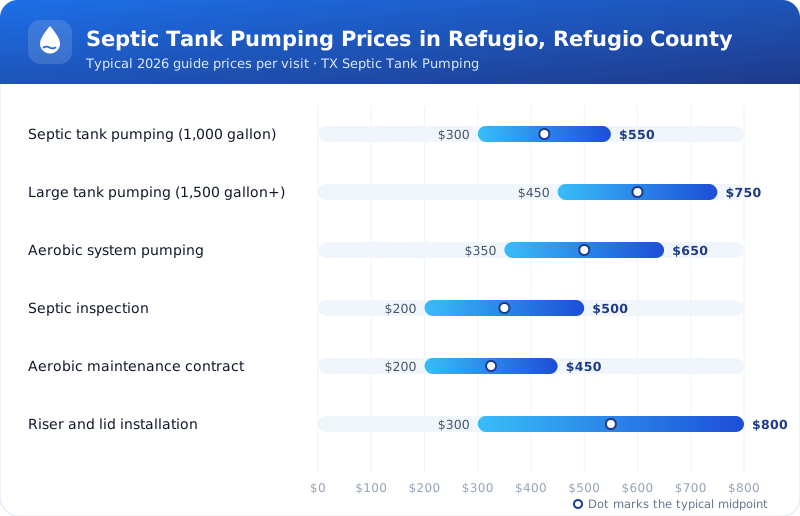
Search results for Alpha also show a posted rate of $175 per tank for tanks up to 500 gallons. Treat that as a listing detail, not a quote. A standard 1,000 gallon tank is larger than that stated range, so ask directly what the company charges for your tank size. Our guide range for a 1,000 gallon tank is $300 to $550.
The listing does not describe weekend service or emergency callouts, so ask about those when you call. Good questions to ask include how long the visit takes, whether the crew checks the baffles and outlet, and whether you will receive a written note of the sludge level.
Before You Book in Refugio
A few minutes of preparation can prevent wasted trips and surprise charges. Run through this list before the crew arrives:
- Find the date of the last pump-out, or note that you do not know it
- Know your tank size if it is printed on permits or plans, or ask the company to measure
- Confirm whether the home has a conventional tank or an aerobic system
- Clear a path to the lid and move vehicles, fences and stored items out of the way
- Confirm whether a grease trap is also present and needs pumping
- Ask for the full price, including any lid location fee or weekend charge
- Stop heavy water use, such as long showers and laundry, on the day of service
- Ask for a written record of the visit
Ridex and Septic Additives: What the General Guidance Says
Ridex and similar septic additives are sold as a way to keep a tank working between pump-outs. Widely accepted general guidance is that additives do not remove the sludge that builds up in a tank, and they do not replace pumping. Solids still need to be physically removed.
If you choose to use an additive, treat it as an extra step rather than a substitute for the regular schedule. A tank that has been pumped and is used normally is the baseline. Keep the three to five year interval in place no matter what product is in the toilet.