Septic tank pumping companies · Montague County
Listings last refreshed October 16, 2026
2 Best Septic Tank Pumping Companies in Nocona [2026 Update]
2 septic tank pumping companies in Nocona, ranked by Pump Score using Google reviews and profile data.
✓ How we rankFree directory, no pay-to-rank
Anyone searching for septic tank pumping Nocona TX will find only two companies in town, both listed under ZIP code 76255. A small local pool makes the choice easier than it would be in a larger city, but it also means you should know what to ask before you book a visit.
Top Rated Septic Tank Pumping Companies in Nocona Compared
Compare the top picks side by side. Full write-ups follow below.
| # | Septic Company | Best for | Score | Rating | Verified |
|---|---|---|---|---|---|
| #1 | Pump Service Co | A local septic company you can call direct | 1.5 | 1 reviews | — |
| #2 | Reed Septic & Backhoe | A local septic company you can call direct | 1.5 | 1 reviews | — |
Nocona Septic Tank Pumping Reviews and Ratings
1. Pump Service Co
Best for: A local septic company you can call direct
711 Clay St1 reviews
Score breakdown and details
- Location
- Nocona · 711 Clay St, Nocona, TX 76255
- Track record
- New or lightly reviewed
- Rating
- 1 Google reviews
- Profile
- Unclaimed listing (Google data)
- Today
- Hours not published
Strengths
- Direct phone number published, no lead form in the way
Watch Out For
Only 1 reviews so far, so the rating could still move. Worth asking about experience.
Our take: Our top pick in this area. A Pump Score of 1.5/10 reflects the best combination of rating, review depth and profile completeness here.
2. Reed Septic & Backhoe
Best for: A local septic company you can call direct
309 Sherman St1 reviews
Score breakdown and details
- Location
- Nocona · 309 Sherman St, Nocona, TX 76255
- Track record
- New or lightly reviewed
- Rating
- 1 Google reviews
- Profile
- Unclaimed listing (Google data)
- Today
- Hours not published
Strengths
- Direct phone number published, no lead form in the way
Watch Out For
Only 1 reviews so far, so the rating could still move. Worth asking about experience.
Our take: A strong shortlist option with a Pump Score of 1.5/10. Compare availability and price against the septic companies above.
Hiring Local Septic Tank Pumping in Nocona
A septic tank collects solids from your household waste and lets liquids drain out to the drain field. Solids build up over time, and once they reach the outlet they can clog the field and cause backups. Most households need the tank pumped every three to five years, though the right schedule depends on tank size, how many people live in the home, and what goes down the drain. Homes on rural lots outside town often rely on tanks more heavily because they may not have a sewer line to fall back on.
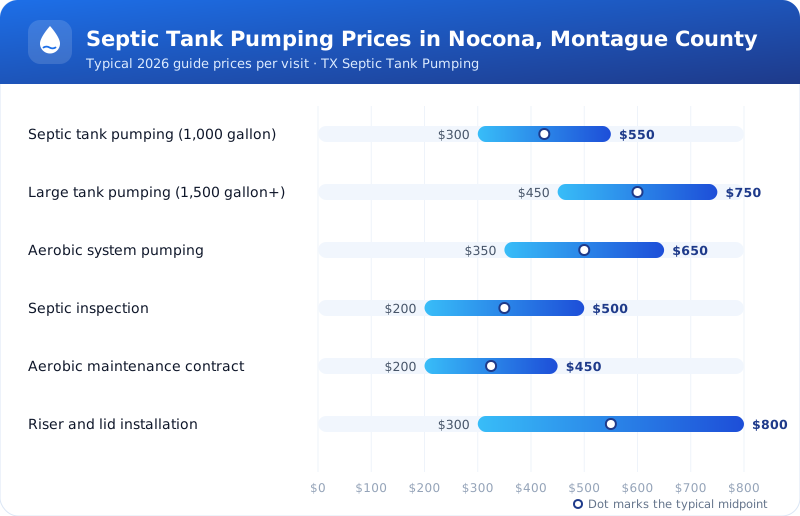
This page walks through the local options, explains how often a 1,000 gallon tank usually needs service, lists the warning signs that a tank is overdue, and covers the basic rules that apply to septic systems in Texas. It also gives guide prices so you can judge a quote when it arrives.
Checklist for Choosing Between the Two Nocona Companies
The two companies below are listed in the order our directory ranks them. Both have one Google review in our data, so reviews alone will not settle the choice. Call each one and ask the same set of questions so you can compare answers directly.
- Confirm the company services your address, especially if you live outside Nocona city limits.
- Ask whether the price includes locating and uncovering the tank lid, or whether that is a separate charge.
- Ask if they pump only, or if they also inspect the tank, check the baffles, and look at the outlet filter.
- If your home has an aerobic system, ask whether they handle that type and whether a maintenance contract is available.
- Ask how they handle emergencies and whether after hours or weekend callouts carry an added fee.
- Request the total in writing before work begins so you know what you are approving.
How Often a 1,000 Gallon Septic Tank in Nocona Needs Pumping
A 1,000 gallon tank is the most common size for single family homes. The usual guideline is pumping every three to five years, but that range is a starting point. A tank that serves a large family, a home with a garbage disposal, or a property with heavy water use will fill faster than one serving two people who rarely run the washer.
Use these factors to decide where your home falls in the range:
- Household size. More daily users means more solids entering the tank each week.
- Garbage disposal use. Ground food adds solids that settle faster than most household waste.
- Water use. Long showers, frequent laundry, and leaks all send extra water through the system.
- Tank age and past service. An older tank that has never been inspected may need pumping sooner.
- Warning signs. Slow drains or odors between scheduled visits mean the tank may already be near capacity.
Warning Signs Your Tank Is Due Before the Schedule Says So
Most tank problems give a few clues before they become expensive. Slow draining sinks and tubs are often the first sign that solids have reached the outlet or that the drain field is struggling to take in liquid. Gurgling pipes, sewage odors near the tank or the drain field, and wet or unusually green patches of grass over the field also point to a system that needs attention.
If you notice any of these signs, call a licensed provider to inspect the tank rather than waiting for the next scheduled pumping. Early service often costs less than repairing a drain field, and a short inspection can confirm whether pumping alone will solve the problem.
Conventional or Aerobic: How the Two System Types Differ
Many searchers want to know which type of system they have before calling a pumper, because the two designs need different care. A conventional system relies on a tank that separates solids and liquids without added air. An aerobic system adds air to speed up breakdown of waste, and it usually includes a mechanical part that needs regular servicing. Check your permit file or the system layout drawing if you are unsure which type you have.
| Feature | Conventional system | Aerobic system |
|---|---|---|
| How waste is treated | Solids settle in the tank and liquid drains to the field | Air is added to break down waste before it leaves the tank |
| Typical pumping guide price | $300 to $550 for a 1,000 gallon tank | $350 to $650 for aerobic pumping |
| Ongoing service | Pumping every three to five years | Yearly maintenance contract, typically $200 to $450 |
| Main moving parts | Usually none in the tank | Air pump, controls, and spray or drip components |
| Common attention points | Solids buildup and drain field health | Air pump function, alarm, and effluent filter |
What Goes Down the Drain in Aerobic and Conventional Systems
Flushing habits matter for both system types. Standard toilet paper is generally acceptable in a conventional system, but wipes, paper towels, and feminine products are not. Aerobic systems tend to be more sensitive to material that does not break down, because the treatment process depends on a balance of air and living organisms. Ask your service provider which products the manufacturer recommends for your unit, and follow those instructions on every visit.
Grease, chemical drain cleaners, paint thinners, and large amounts of bleach should stay out of both system types. Keep the effluent filter clean if your system has one, since a blocked filter can send solids to the drain field.
Texas Rules That Apply to Septic Systems Near Nocona
The Texas Commission on Environmental Quality, usually called TCEQ, regulates on-site sewage facilities across the state, which includes septic tanks and aerobic systems. Rules cover how systems are designed, installed, and maintained, and the agency is the right place to check current requirements before you start work on a tank or drain field.
Because local details can change, confirm with TCEQ or your county office before you install a new system, replace a tank, or make a major repair. Ask whether your property has an existing permit or record, since that file often shows tank size, system type, and the location of the drain field. Having that information on hand will make any pumping or inspection visit more accurate.
What to Expect on a Septic Pumping Visit
A typical visit is straightforward. The steps below describe the general flow, though each company may handle details a little differently.
- Locate and uncover the tankThe technician finds the access lid, which may be buried under soil or grass. If the lid is hard to find, uncovering it may be a separate charge of $50 to $200.
- Check the lid and risersRisers make future pumping easier and cheaper. If your tank has no risers, a riser and lid installation may cost $300 to $800.
- Pump the tankThe tank is emptied of its solids and liquids. Expect this step to be the core of the bill, with 1,000 gallon tanks commonly falling between $300 and $550.
- Inspect the interiorA good provider looks at the baffles, the outlet, and the condition of the tank walls. An inspection on its own commonly runs $200 to $500.
- Record the serviceAsk for a written record that shows the date, the pumping, and any issues found. Keep it with your permit file.